Field Note · 2 September 2026
What Is an AI Buildathon? A Practical Guide for Teams
A buildathon compresses problem framing, AI-assisted making, testing and decision-making into one working session. Here is how to design one that survives the room.
- Filed
- 2 September 2026
- Author
- Dima Abramov
- Reading time
- 6 min
- Topics
- Buildathons · AI Enablement · Teams · Guide
- Share
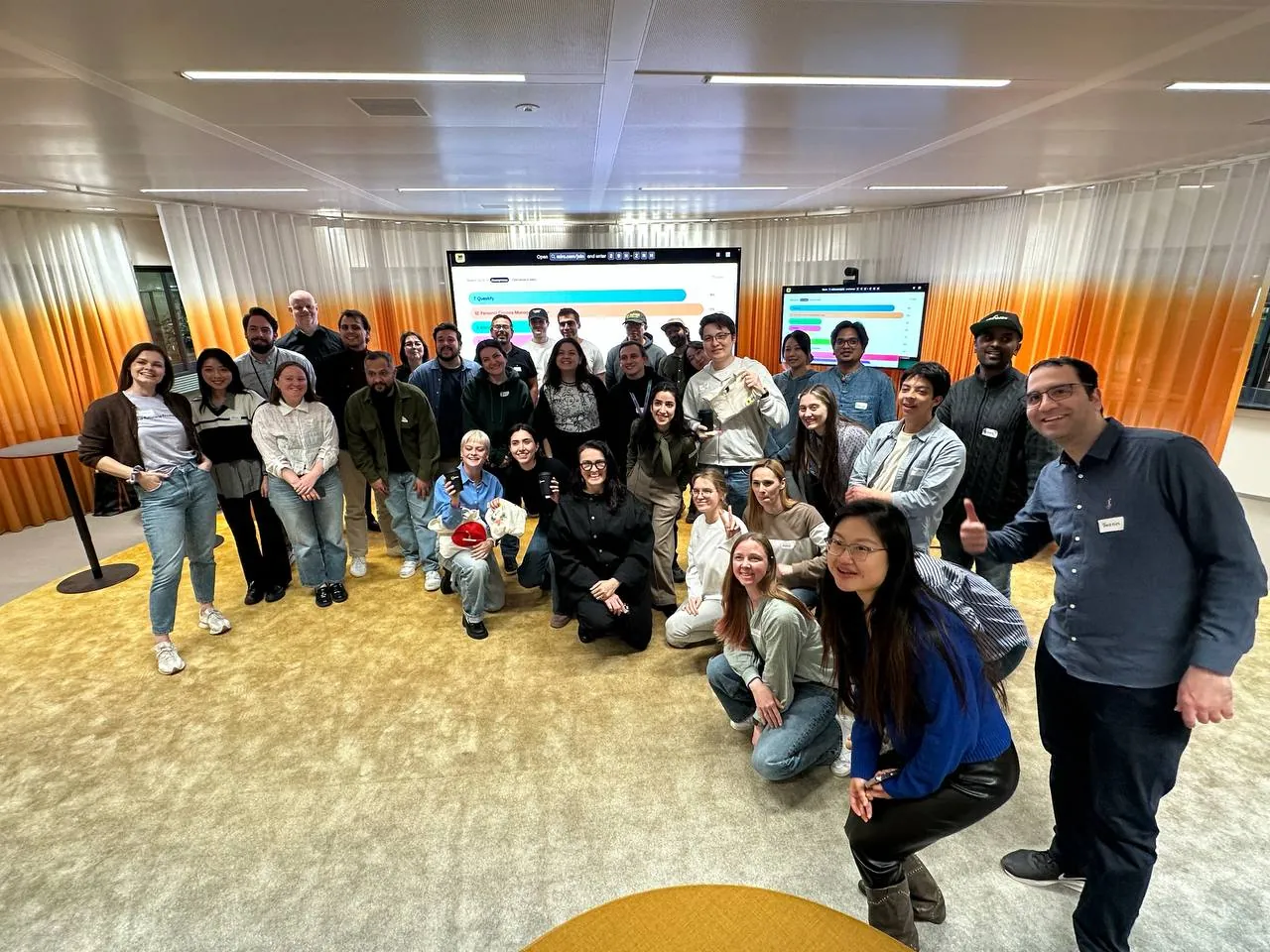
An AI buildathon is a time-boxed working session in which teams turn a real problem into a functional, testable prototype using AI-assisted tools.
The important words are not AI or prototype. They are real problem and testable.
A useful buildathon is not a training course with a competition attached. It is a compressed product cycle: understand the situation, choose what to prove, build the core flow, review the result and decide what happens next.
Who an AI buildathon is for
The format works best with mixed teams.
Product, design and research bring user context and the ability to frame the problem.
Operations, sales, service and domain specialists know where work is slow, risky or unnecessarily manual.
Engineers and data specialists expose technical constraints and help promising prototypes avoid avoidable dead ends.
Leaders create permission, remove access barriers and commit to the follow-through.
Participants do not all need coding experience. They do need a problem close enough to their work that they can recognise a bad solution.
AI lowers the entry barrier to making. Domain knowledge determines whether the thing being made deserves to exist.
What teams should leave with
A buildathon should produce more than a gallery of attractive screens.
Each team should leave with:
A specific problem and user, written in language the team still believes.
A working core flow that another person can experience.
A record of assumptions, data needs and unresolved risks.
Evidence from a demo, test or expert review.
A named owner and one next action.
A decision date.
The prototype can be rough. The next move should not be.
Choose the format
Half-day: activate
Use a half-day when the objective is to introduce the method, build confidence and produce small workflow prototypes. Keep the brief narrow and the setup ready.
Full day: solve
A full day gives teams enough time to frame a real problem, build, test with peers and revise. This is the strongest default for an internal team.
Two days: expand
Use two days when teams need access to multiple experts, more complex integrations or an external final. Protect time for sleep, review and a second build cycle.
Multi-week: continue
For problems involving real data, security, policy or users, the event should be the opening sprint in a longer programme. Short checkpoints after the buildathon matter more than adding hours to the event.
Step 1: define the business movement
Begin with the change the organisation needs, not the event it wants to host.
Examples:
Product managers can test an idea without waiting for the full roadmap cycle.
Operations teams can prototype automations around repetitive work.
Customer teams can make recurring service problems visible.
Leaders can identify builders and use cases for a wider AI adoption programme.
Write the thirty-day outcome before writing the agenda.
Step 2: collect problems
Ask participants and sponsors for situations, not solution pitches.
A useful problem statement names who is affected, what they are trying to do, what happens today and why that matters. It does not begin with “we need an agent.”
Review the problems for four qualities: relevance, access to context, suitability for a prototype and an owner prepared to continue.
Step 3: design the brief
A good brief creates pressure without prescribing the answer.
Include:
The situation and the people involved.
The outcome that would improve.
Available data, systems and subject-matter experts.
Constraints around privacy, security, regulation and brand.
What a credible prototype must demonstrate.
What is explicitly out of scope.
Teams should have freedom inside a boundary they understand.
Step 4: prepare the environment
The fastest way to waste a buildathon is to discover access problems after the clock starts.
Before the event, test accounts, credits, connectors, authentication, sample data, venue Wi-Fi and presentation equipment. Decide what production data may not enter AI tools.
Provide a safe route for teams that do not receive access. Synthetic data and mocked integrations are better than improvised security.
Step 5: form mixed teams
Teams of three to five usually create enough range without turning coordination into the main task.
Avoid grouping every engineer together. A useful team combines problem knowledge, product judgment, making ability and the confidence to show unfinished work.
Give each team explicit roles for the first hour. Roles can change, but nobody should spend the event waiting to become useful.
Step 6: run the build loop
The core loop is simple:
Situation: describe what is happening now.
Objective: name the behaviour or outcome that should change.
Build: make the smallest credible path.
Review: put it in front of another person.
Decide: revise, continue or stop.
Mentors should ask which decision a team is stuck on before touching the keyboard.
Step 7: use checkpoints
A visible schedule prevents teams from polishing the wrong thing.
Problem check: can the team state the user and tension?
Scope check: what will the demo prove?
Working-flow check: can another person complete the central action?
Risk check: what data, permission or reliability issue would block a pilot?
Demo check: what changed because the team built it?
Checkpoints are not status theatre. They create moments when a team can still change direction.
Step 8: judge the work
Judging criteria should reward the behaviour the programme wants.
Problem clarity and relevance.
Coherence of the proposed change.
A functioning core flow.
Responsible use of data and AI.
Quality of learning and iteration.
Credibility of the next step.
Do not reward complexity by default. A small product that changes one real workflow may be more valuable than an ambitious system nobody can safely continue.
Step 9: design the follow-through
Before the final demo, decide what promising teams can receive: access to a product owner, engineering review, security support, user testing, a small continuation budget or a place in an internal incubator.
Set the next checkpoint within two weeks. Momentum expires quickly when a prototype returns to the normal queue.
What can go wrong
The brief is a technology prompt rather than a problem.
Senior leaders open the event and disappear before the demos.
Teams cannot access the systems or data they need.
Mentors build for participants instead of helping them decide.
Judges reward visual polish and ignore feasibility.
Nobody owns the result after the photographs.
All of these failures are design choices. They can be fixed before the event.
How to know it worked
Track participation and outputs, but do not stop there.
Look for activated builders, cross-functional collaboration, prototypes tested with real people, decisions made and work that continued thirty or sixty days later.
A buildathon is successful when the organisation behaves differently after the room—not merely when the room felt energetic.
The companion guide Hackathon vs Buildathon explains the distinction between the formats. My Maven session, How to Drive AI Adoption with a Buildathon goes deeper into using the model inside organisations.
If you want a buildathon designed around your team, data and real problems, book a working session with CraftingProduct.