Field Note · 15 September 2025
Vibe Coding: Fast Prototyping With Context
What is vibe coding? A product manager's honest 4-month review of AI coding tools like Lovable, Replit, and V0. Real results, limitations, and practical advice.
- Filed
- 15 September 2025
- Author
- Dmitrii Abramov
- Reading time
- 3 min
- Share
I first heard about vibe coding on Lenny's Podcast and had an immediate "wow, that's cool" moment. As a product person with no practical coding experience, the idea that I could actually build something functional with AI tools was genuinely exciting. This was my a-ha moment—I saw a path to create working prototypes without depending entirely on developers.
That excitement is what drove me to start the Amsterdam meetups. I wanted to understand the real-world value of these tools and explore how they might change product teams in the future.
What is Vibe Coding?
Vibe coding is a development approach where you use natural language prompts to instruct AI tools to generate, refine, and debug code. Coined by AI researcher Andrej Karpathy, it's about "forgetting that the code even exists" and focusing on describing what you want your software to do rather than how to implement it.
Instead of writing code line by line, you tell an AI tool like Lovable, Replit, or V0 what kind of application you want to build, and it generates the code for you. The "vibe" refers to communicating your intent and letting AI handle the technical implementation.
But I was curious enough to spend my summer testing it. I built craftingproduct.io entirely with Lovable, started meetups in Amsterdam, and experimented with my product team.
What I Built and Why It Matters
To understand vibe coding's potential, here's what I actually created with these tools:
For craftingproduct.io, I built a complete content management system using only natural language prompts. The screenshot above shows the actual content editor I'm using to write this post - complete with SEO optimisation, social media previews, draft management, and publishing workflows.
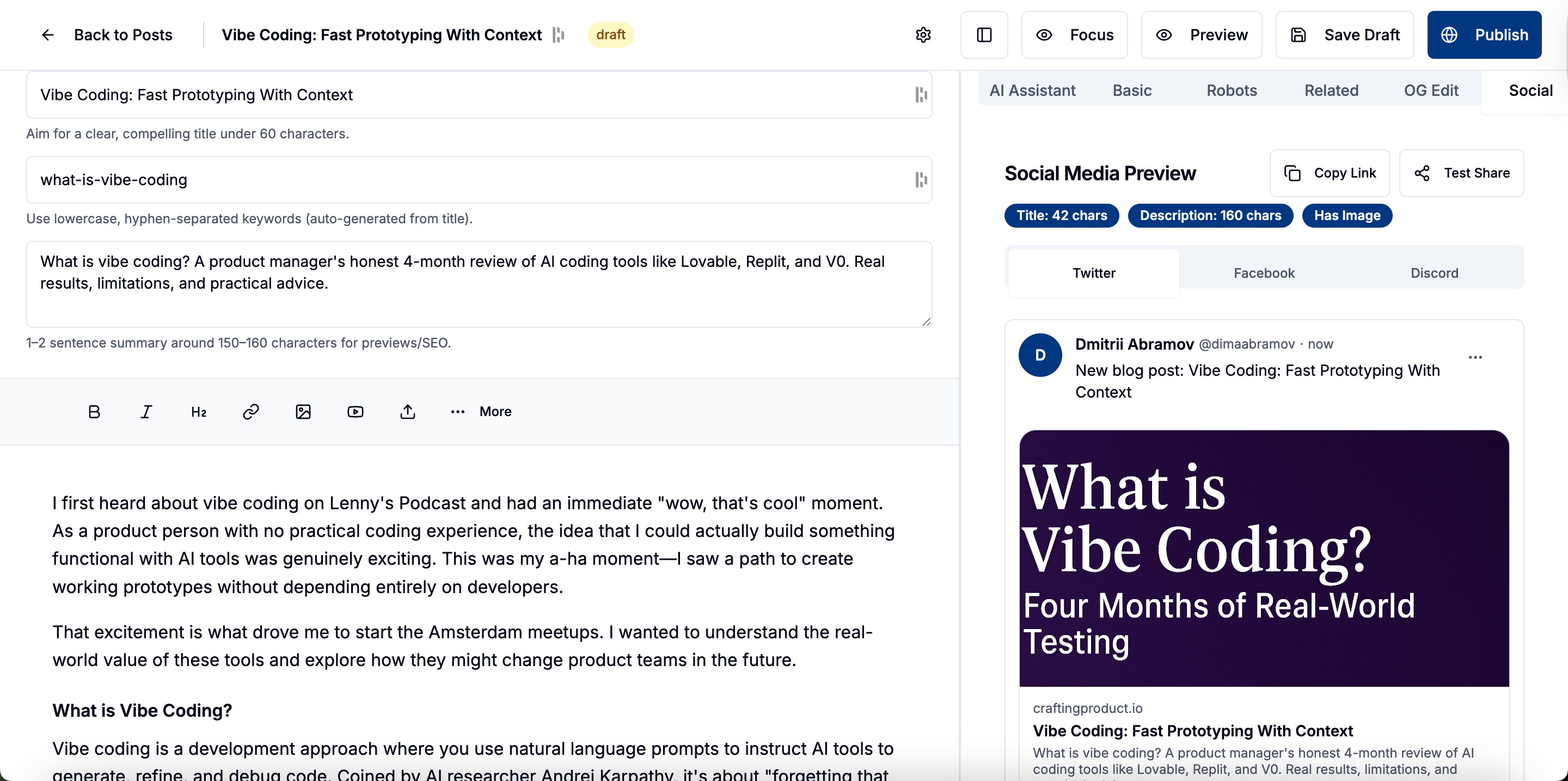
The key insight: this isn't just a prototype or mockup. This is the actual editor I use to publish content to my website. As someone without coding background, building production-quality tools felt transformational.
The Future I See Coming
This is just the beginning. Teams starting fresh with vibe coding tools today can potentially ship production code with proper validation and testing workflows. The challenge is for teams with extensive legacy codebases—integration becomes the barrier, not the tools themselves.
I expect significant resistance from development teams who'll inherit AI-generated code. That scepticism is understandable and often justified. But teams that embrace these tools from the start, building proper review processes and quality controls, will have competitive advantages.
The development process itself is changing. We're moving toward a world where product managers can build functional prototypes independently, designers can create working interfaces, and validation cycles become dramatically faster.
This isn't about replacing developers—it's about expanding who can participate in the creation process and accelerating the feedback loops that matter most for building successful products.
References and Further Reading
Andrej Karpathy's Tweet on Vibe Coding - The original definition that started the conversation
Lenny's Podcast - Where I first heard about the concept
Google Cloud: What is Vibe Coding - Enterprise perspective on AI-assisted development
Replit Blog: What is Vibe Coding - Platform-specific take on natural language programming
Lovable Blog: Vibe Coding Explained - Focus on democratizing software development
The Purpose of Prototypes - SVPG - Marty Cagan's framework that influenced my approach to using these tools
Tools Mentioned:
Lovable - AI coding platform I used for craftingproduct.io
Replit - Browser-based development environment with AI features
Figma Make - Figma's AI-powered code generation tool