Field Note · 2 September 2026
AI Workshop or AI Training? Choose Based on What Must Change
Training transfers knowledge. A workshop changes a situation with the people who own it. The right format depends on the behaviour you need afterwards.
- Filed
- 2 September 2026
- Author
- Dima Abramov
- Reading time
- 5 min
- Topics
- AI Workshops · Training · AI Enablement · Guide
- Share
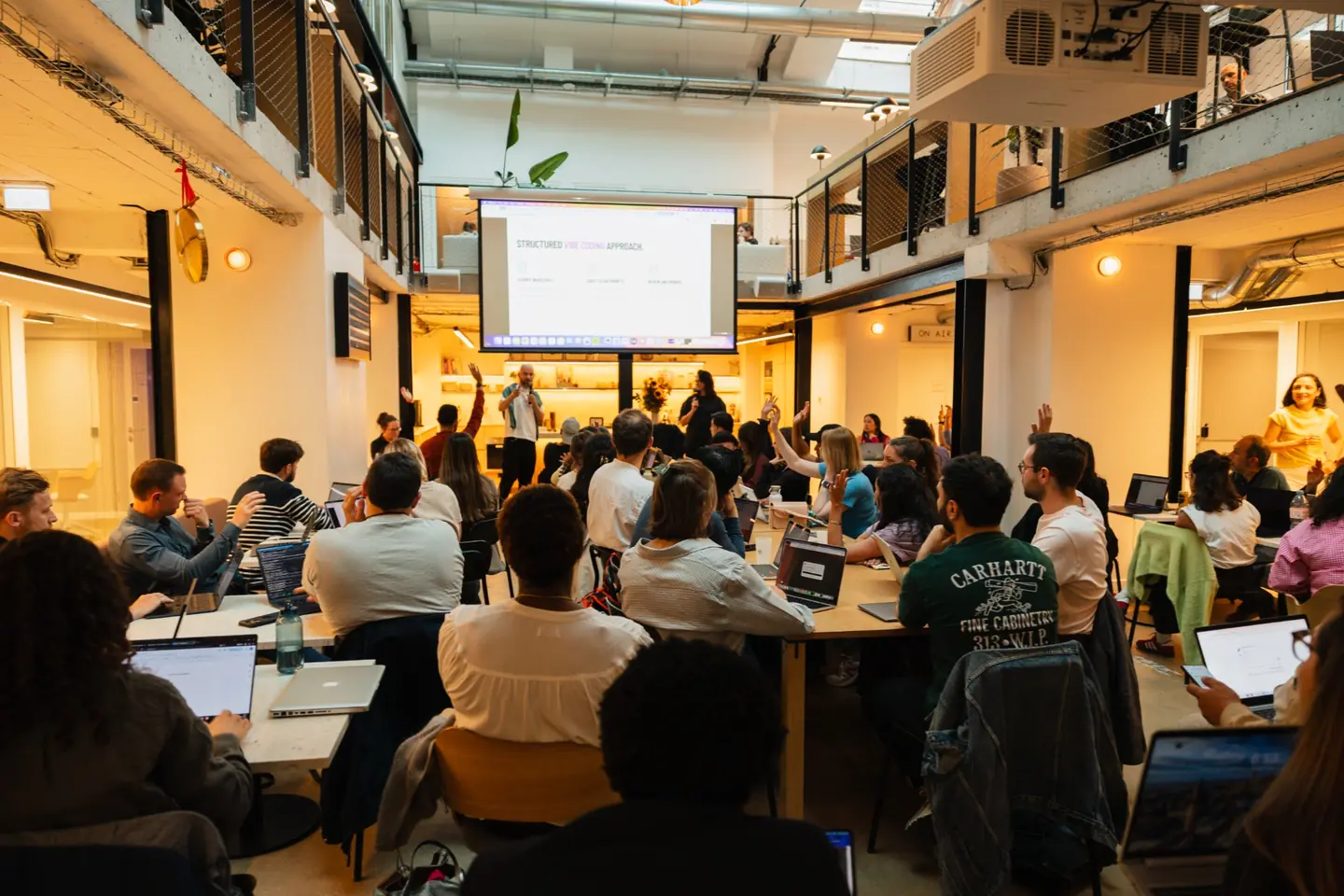
Teams often ask for an AI workshop when they mean training—and training when the organisation actually needs to change a workflow.
Both formats can be useful. Confusing them creates disappointed participants and outcomes nobody can explain.
Choose the format by completing one sentence: after this session, people must be able to…
AI training transfers a repeatable skill
Training is appropriate when a defined group needs shared knowledge or a method they can practise across many situations.
Examples include:
Using an approved AI assistant safely.
Writing and evaluating prompts for a known task.
Understanding model limits, data rules and escalation paths.
Learning the basic workflow of Lovable, Claude, Codex or another platform.
Applying a standard review checklist to AI output.
The trainer knows the core material before the room begins. Exercises are designed to expose predictable mistakes. Success can be assessed through demonstrated skill, confidence and later use.
Good training reduces dependence on the trainer.
An AI workshop changes a specific situation
A workshop is appropriate when the answer is not known in advance.
The team brings a real problem, process, product opportunity or decision. The facilitator provides structure, questions and making support. Participants contribute the context needed to create the outcome.
Examples include:
Redesigning a service workflow with AI assistance.
Prototyping an internal tool around a recurring operational problem.
Turning a product idea into a testable flow.
Defining where agents should—and should not—act.
Creating an adoption plan for one team or function.
The facilitator cannot arrive with the final answer because the answer depends on the organisation.
Good workshops reduce uncertainty around the next move.
The easiest diagnostic
Ask whether every participant should leave with the same answer.
If yes, you probably need training. Everyone should understand the policy, demonstrate the workflow or apply the skill.
If no, you probably need a workshop. Different teams may leave with different prototypes, decisions or experiments because their situations differ.
Training without context becomes trivia
A tour of AI tools can create temporary excitement and little change.
People remember impressive capabilities but cannot connect them to Tuesday morning. The organisation then interprets low usage as resistance.
Useful training includes examples from the audience’s work, approved environments and a practice task close enough to be recognisable.
The objective is not tool knowledge. It is competent behaviour.
A workshop without preparation becomes conversation
Calling a meeting a workshop does not make it productive.
A working session needs a problem owner, relevant participants, access to enough context, constraints and a definition of what should exist by the end.
For an AI workshop, that usually means:
A clear situation and user.
Approved tools and data boundaries.
A working build or workflow, not only ideas.
Review by another participant or expert.
A next action, owner and date.
The room should make something or decide something.
When to combine them
Many teams need both.
Use short training before the workshop when participants require a shared baseline. Then move quickly into real work.
A useful combined day might look like this:
Forty-five minutes: safe use, core method and a live example.
Thirty minutes: frame the team’s real problem.
Two hours: build the smallest working flow.
Thirty minutes: peer test and review.
Thirty minutes: risks, next steps and ownership.
Keep the training portion only as long as necessary for participation. People learn the tool more deeply when a real problem demands it.
Match the facilitator to the job
A trainer needs subject mastery, clear explanations and exercises that build competence.
A workshop facilitator needs to manage ambiguity, challenge assumptions, create decisions and help a mixed group build together.
The same person can do both, but the posture is different.
In training, I may know the route. In a workshop, I protect the procedure while the team discovers the route.
How to measure each format
Training
Can participants perform the target task?
Do they understand the boundaries and risks?
Do they use the method later without support?
Does output quality or time improve?
Workshop
Was the real problem made more specific?
Did the team create a working artefact or decision?
Was the result reviewed with relevant people?
Is there an owner and next action?
Did the work continue?
Satisfaction matters, but it is not the outcome.
Common mismatches
A leadership team asks for prompt training when it needs to decide where AI belongs in the operating model.
A product team asks for strategy when it needs a day to build and test the first flow.
An organisation requests a workshop for hundreds of people when it needs scalable foundational training.
A transformation programme trains everyone on tools before clarifying what safe, useful work looks like.
The format should follow the change.
Choose the verb
Teach, practise and certify point toward training.
Frame, redesign, build, test and decide point toward a workshop.
If the brief contains both sets of verbs, sequence them. Do not let a long presentation consume the working time.
Your AI transformation does not always need a workshop. Sometimes people genuinely need instruction.
But when the problem is specific, cross-functional and unresolved, another presentation will not move it.
Our For Teams page covers workshops and buildathons designed around real organisational problems. The practical AI buildathon guide shows how the working format operates.
Tell us what must be different after the session. We will help choose the format—and say when a workshop is not the right answer.