Field Note · 2 September 2026
How to Run an AI Buildathon Without Creating Theatre
Big rooms, partner logos and fast prototypes can look like transformation. The real test is whether the work changes a decision after everyone goes home.
- Filed
- 2 September 2026
- Author
- Dima Abramov
- Reading time
- 5 min
- Topics
- Buildathons · AI Transformation · Leadership · Guide
- Share
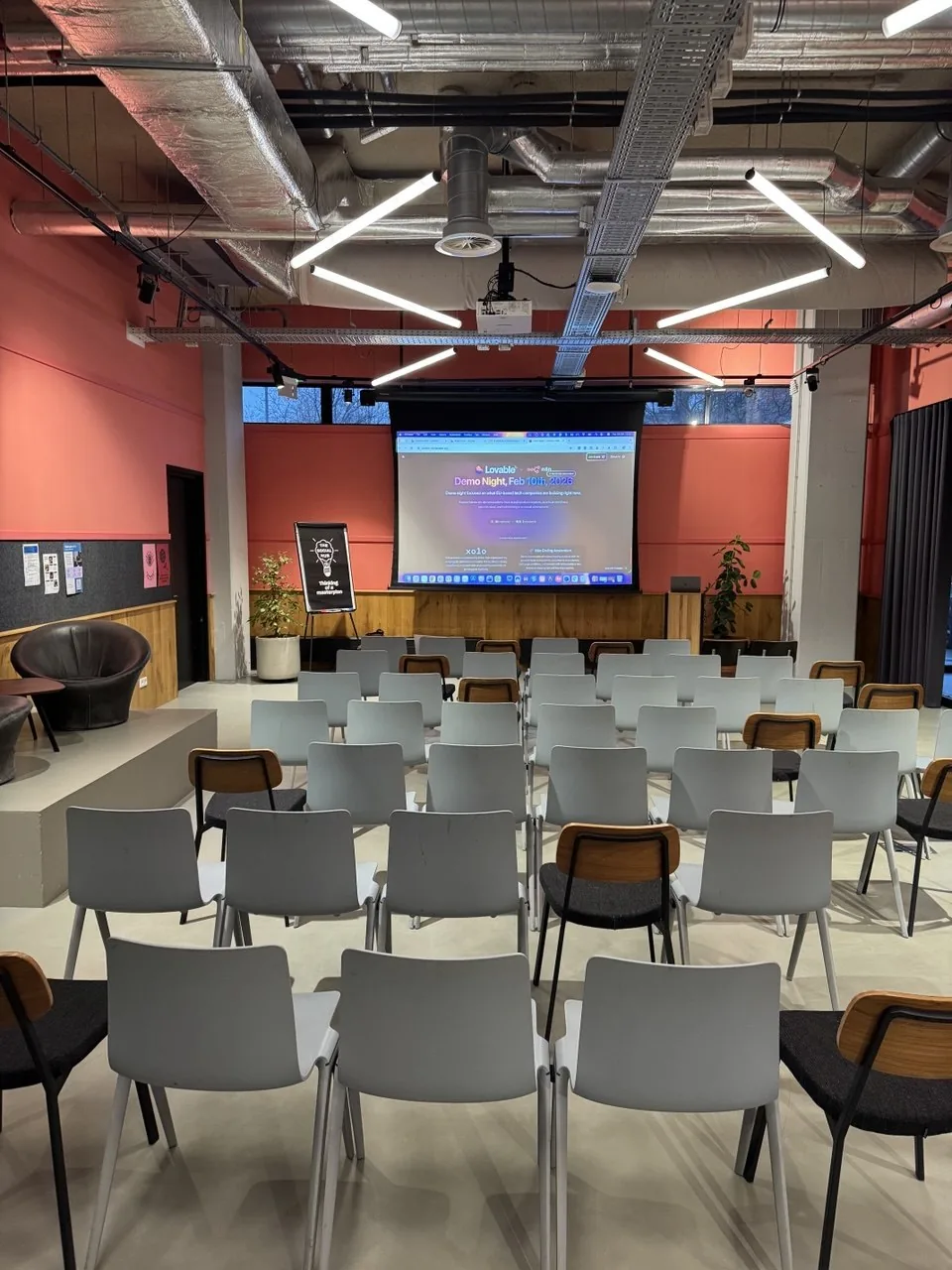
An AI buildathon can create the perfect photograph of change.
Senior leaders open the day. Teams lean over laptops. Prototypes appear. Judges choose winners. Everyone leaves with evidence that the organisation is innovative.
Then Monday arrives and nothing in the organisation behaves differently.
That is theatre: activity designed to represent movement without carrying the cost of movement.
Start with the decision after the event
Before booking the venue, name the decision the buildathon must make possible.
Which internal workflow should move into a pilot?
Which people should join an AI builder programme?
Which product assumption deserves a user test?
Which data or policy barrier must leadership remove?
Which idea should the organisation stop discussing?
If no decision is attached, the event can only produce artefacts.
Use problems the organisation is prepared to touch
Theatre begins when teams receive safe, generic challenges while the important work remains protected from examination.
A real problem has an owner, history, constraints and consequences. The owner should be in the room. They should be prepared to hear that the current process is incoherent or that the proposed AI solution is unnecessary.
Not every problem is suitable. Sensitive data, irreversible decisions or complex production dependencies may require a mocked flow. But the situation should still be real.
Bring the people who live with the work
A buildathon assembled only from volunteers and innovation enthusiasts creates an unusually motivated sample.
Include the operations specialist who knows the exception, the customer-facing colleague who sees failure, the engineer who understands the boundary and the leader who can approve the next step.
Do not use domain experts as a briefing resource and send them away. Keep them inside the build.
Make leadership stay for the evidence
An opening speech is not sponsorship.
Leaders should review the problems, remove access blockers, attend the demos and answer what can continue. Their job is not to select the most impressive interface. It is to absorb what the prototypes reveal about the organisation.
If the people with authority leave after the welcome, teams learn that the event is peripheral.
Reward learning, not volume
AI makes it easy to produce many screens. That is a poor scoring criterion.
Judge whether a team:
understood a consequential problem;
made a clear assumption testable;
built a coherent central flow;
used data and AI responsibly;
changed direction when evidence demanded it;
defined a credible next move.
A team that discards a weak idea may have learned more than a team that generated a beautiful application.
Show the joins
Every prototype has invisible support: copied data, manual interventions, credentials, prompts, human judgment and parts that only work in the demo.
Ask teams to name them.
A responsible final presentation includes what is real, what is simulated, what would fail at scale and what requires security or engineering review.
This does not weaken the pitch. It makes the prototype useful to the people deciding what happens next.
Fund continuation before the event
The most common failure is asking winning teams to continue “if they have time.”
Reserve capacity in advance: a product owner, technical review, user access, security support and a small continuation budget. Put the first checkpoint on the calendar before the buildathon begins.
Without protected follow-through, the normal organisation will absorb the prototype.
Measure thirty days later
The event survey tells you whether people enjoyed the day. It does not tell you whether the format changed capability.
Return after thirty and sixty days. Ask:
How many prototypes received a real review?
Which teams ran a user or workflow test?
What moved into a pilot?
What was stopped, and why?
Which participants continued building?
What blocker did leadership remove?
Continuation is not the only valid outcome. A well-evidenced decision not to proceed is also progress.
Keep the room human
Avoiding theatre does not mean removing celebration. Buildathons should have energy, generosity and a sense of occasion.
The celebration should belong to the work: the first-time builder who recovered, the domain expert who made an edge case visible, the team that simplified its idea, the prototype that created a difficult but useful conversation.
That is a better story than pretending every demo is a future company.
A simple anti-theatre checklist
The event has a business decision, not only a theme.
Every challenge has an owner in the room.
Teams have safe access to enough context to build.
Leaders attend the evidence, not only the opening.
Judging rewards learning and responsibility.
Prototype limits are stated openly.
Continuation capacity exists before winners are chosen.
Outcomes are reviewed after the energy has faded.
If several of these are missing, redesign the event before making it larger.
Transformation has a Monday
A buildathon is a temporary environment where an organisation can work differently. Its value is the bridge back to normal work.
The event matters when a team keeps using the method, a workflow enters a pilot, a leader changes a constraint or a participant realises they can make something they previously only requested.
That is less cinematic than a stage full of winners. It is also what transformation looks like.
For the full operating sequence, read What Is an AI Buildathon?. The Maven session How to Drive AI Adoption with a Buildathon covers the organisational case in more depth.
If you want a buildathon tied to a real Monday, talk to CraftingProduct about the problem and the follow-through.